
A Pisces Stellium in the 3rd House
Tracking the Trajectory of a Life
By Glenn Perry
As elaborated in a previous article, the zodiac is a natural lifespan developmental model. Each sign and its corollary house represents a developmental stage of specific duration. Beginning with Aries, which is the first two years of life, each subsequent sign-stage is one year longer than the sign it succeeds. Taurus is three years duration (2-5), Gemini four years duration (5-9), and so forth. The same logic follows the sequence of houses. Most notably, a planet in a house marks a particular age-point of one to two years duration within the developmental stage that house represents.

Angela Age 7
As a way of grounding our astro-developmental model, I will present a brief case history of a 72-year old former client, Angela, who has a Pisces stellium in her 3rd house (see Figure 1). A stellium refers to four or more planets in the same sign or house and constitutes a mass of unrestrained, forward-moving energy―like the tip of a spear or a stampede of wild horses. The 3rd house signifies ages 5 to 9, which is when we enter school and commence the task of learning to read and write. It is the Gemini stage of life.
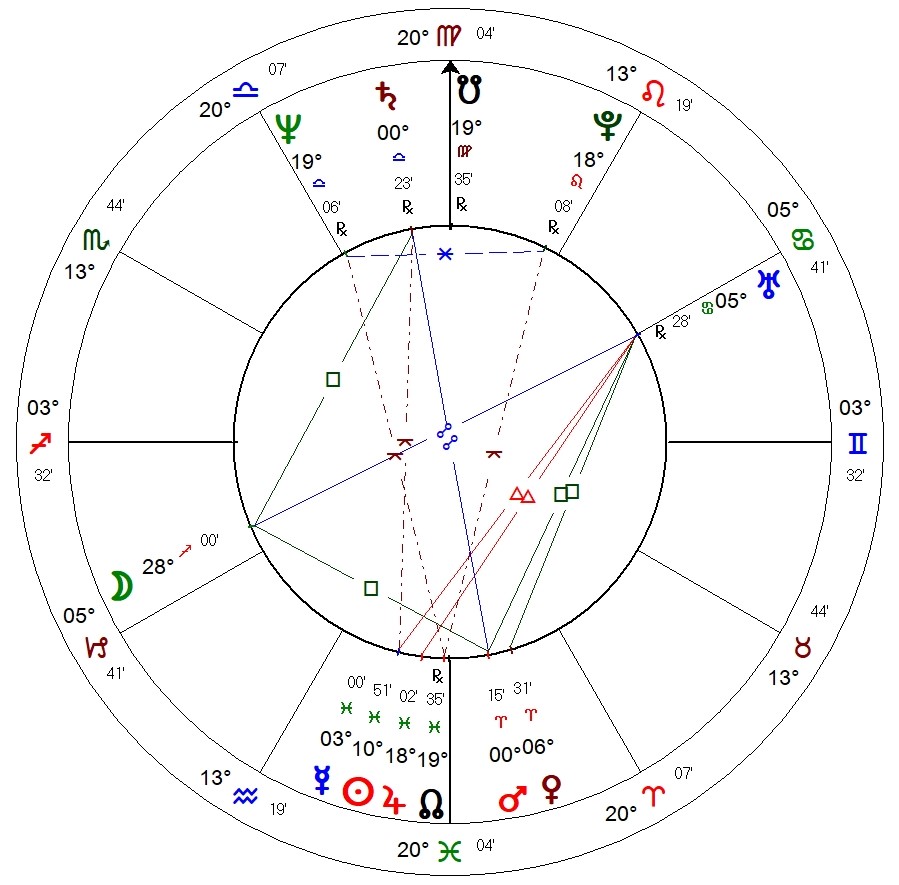
Figure 1: Angela’s Chart
In Angela’s case, her Mercury Pisces sits right in the middle of the 3rd, signifying age 7, which is followed by the Sun and Jupiter, both in Pisces (I’m including the North Node as part of the stellium, too). The Sun signifies age 8, while Jupiter and the North Node are approaching age 9.
Taken as a whole, Angela’s Pisces-stellium corresponds to 1st through 3rd grade. Predictably, Angela disclosed she was learning-impaired at this time in her life, not because she lacked intelligence, but because her head was in the clouds. Pisces symbolizes the transcendent realm of dreams, visions, and ideals. And that was where Angela preferred to be.
Jupiter’s Yod to Neptune and Pluto
Notice that Jupiter forms a somewhat ominous Yod to Pluto in the 9th and Neptune in the 10th. A Yod is a 3-planet configuration comprised of two planets in sextile (60°) both of which are forming quincunxes (150°) to a third planet―the so-called ‘focal planet’. In this case, the focal planet, Jupiter, is under stress due to a chronic problem or threat it is facing from Neptune and Pluto. In Angela’s chart, Jupiter forms an opening quincunx to Neptune and a closing quincunx to Pluto.
Problems and threats correspond to opening and closing quincunxes respectively, which derive their meaning from the two signs that signify the 150° angle in the natural zodiac. The zodiac starts at the vernal equinox, or 0° Aries, whose angle is effectively 0°. The problem-solving, fix-it sign, Virgo, signifies the opening 150° quincunx to Aries whereas the threat-resolving, crisis-intervening sign, Scorpio, signifies the closing 150° quincunx. This underscores that an aspect derives its meaning from the zodiac sign that naturally constitutes that angle.
The specific nature of the issue symbolized by the Yod is a product of the planets, signs, and houses that comprise it. In effect, the focal planet is forced to work extra hard as if compelled by a state of constant worry (opening quincunx) and fear (closing quincunx) seemingly caused by the two planets that quincunx it. In effect, it’s a situation of two against one. After sufficient life experience has accrued, however, a skill for solving problems and resolving threats may emerge that pertains to the respective planets involved.
Generally speaking, planets in hard aspect tend to overcompensate in an attempt to ward off the influence of the other. This defensive, reactive dynamic may initially bring out the worst in each planet. Since Jupiter forms hard aspects to two planets―Neptune and Pluto―it is doubly challenged. Neptune may inflict a chaos of confusion and Pluto looms as a terrifying power, both making it difficult for Angela to actualize the potential of Jupiter Pisces in the 3rd―especially at age nine, Jupiter’s age-point.
When we consider that Neptune and Pluto’s Yod to Jupiter ties into the four-factor Pisces stellium, thus infusing it with fear and worry, this powerful configuration is analogous to an unhinged quartet of winged horses—Pegasus times four—hitched to a small, rickety chariot occupied by Angela . Unable to focus on her 3rd house schoolwork and ill-equipped to control such raw, elemental forces, her four horses of the apocalypse race upward, carrying Angela away into stormy clouds (see Figure 2).

Figure 2: Angela’s Academic Difficulties
Angela’s Sagittarius Ascendant points us back to her moment of birth, since developmentally the Ascendant marks that threshold. With Jupiter ruling Sagittarius—and thus her 1st house—Jupiter becomes symbolically linked to her entry into the world. This raises the question: might the story of her birth encapsulate, or even foreshadow, the meaning of Jupiter’s Yod to Neptune-Pluto? Were there complications? Was it an emergency?
When interpreting charts, I often utilize a metaphor to capture the essence of a particular configuration, just as I have above with the image of the rickety chariot swept up into the clouds. Yet oftentimes the client provides a real-life experience that more perfectly symbolizes the issue than anything I might imagine.
In one communication, Angela wrote:
This is how I was born: The future raced toward me like a twister. I was born in a flash of lightening, on the wake of a storm, I greeted the world.

How curious that Angela used the word “future” in her description, as if anticipating that her future would be a whirling vortex of chaotic, destructive forces. The future is a principle concern of Jupiter, which symbolizes the act of predicting, prognosticating, and forecasting (including weather forecasting). A “twister” is a powerful tornado comprised of a violently rotating column of air. Its whirling chaos can destroy anything in its path—an apt metaphor for Jupiter’s Yod to Neptune-Pluto.
Keep in mind that Angela’s Jupiter Yod is not only entangled with the birth moment via a kind of resonance, the moment itself symbolizes an experiential and psychological pattern that must be faced and hopefully resolved over the course of her life.
Among other things, Jupiter rules counseling, guiding, and advising. Despite a difficult and tumultuous childhood as well as adult challenges that tend to follow such inauspicious beginnings, Angela achieved early success working in the helping professions as a counselor with people whose problems mirrored her own, except worse. Eventually, she also became an accomplished writer and artist.
Sun Pisces 3rd Disposed by Neptune
With regard to her emergent skills as a writer-artist, Sun Pisces 3rd is particularly relevant along with its dispositor, Neptune. A dispositor rules the sign that the disposed planet occupies, thus receiving and being activated by that planet’s actions—or what we might think of as its vibrational frequency. In this case, Sun Pisces is disposed by Neptune, which means their respective functions and age-points are vibrationally connected in a type of resonance.
Angela has Neptune Libra late in the 10th―the house of career―covering the 12-year period 54-65. Because Neptune sits just before the cusp of the 11th, it marks age 64, while the Sun correlates to age 8. It was precisely at age 64 that Angela published a memoir recounting her painful childhood and the extraordinary quest for identity that led her to the Far East and beyond. In effect, the book was about her Self (Sun), and more specifically about her spiritual unfoldment (Pisces-Neptune).
More importantly, her book was about a spiritual journey, both literally and figuratively. This is an especially apt signature not only of Sun Pisces disposed by Neptune but also of Jupiter Pisces quincunx Neptune. Again, Neptune Libra symbolizes age 64, which is when Angela published her memoir. Jupiter, on the other hand, represents Angela’s capacity to theorize about, publish, and disseminate truths related to philosophy, religion, travel, and/or other topics that pertain to the pursuit of wisdom. Naturally, she didn’t have he maturity to do this at 9-years-old in the 3rd grade, which is Jupiter’s age-point.
Jupiter and Neptune’s opening quincunx implies a problem associated with their respective functions. We might anticipate this problem includes, at the very least, ungrounded flights of fancy, for Jupiter correlates to an expansionary energy and Pisces-Neptune to the unbounded, transcendent realm of imagination. Note that Jupiter is not only in Pisces, it also quincunxes Neptune, the ruler of Pisces. In effect, Jupiter quincunxes its own dispositor, which spells double-trouble (a repeating theme). Imagine a hot-air balloon carrying 9-year old Angela off to outer space rather than being strapped to her chair forced to master mundane skills of counting and spelling (see Figure 3).

Figure 3: Escape from Grammer School
Whatever the problem was, we should not expect anything approaching a solution at age 9 except, perhaps, as a dreamlike vision of her future destiny. It was not until she reached her Neptunian age-point of 64 that the distilled wisdom (Jupiter) of her life could be expressed through her memoir. Mystery and magic were woven together into compelling stories of her travels to the Far East―which, while deeply meaningful, were frequently painful as might be expected with her Jupiter Yod to Neptune-Pluto.
A few years after Angela published her memoir, she wrote another book; this one on the Tarot. Similar to astrology but more imagery-based, the Tarot utilizes a symbolic, pictorial language for purposes of prognostication. Skillful interpretation (Jupiter) of the Tarot’s pictorial symbols (Pisces-Neptune) empowered Angela to predict outcomes for clients concerned about their future.
Such a skill is again a perfect expression of Jupiter’s Yod to Neptune and Pluto―albeit when it functions at an integrated level that is hard won over time. Since the Tarot is an occult/Plutonic art as much as a Neptunian one, we might expect that Pluto added depth and power to her interpretations.
3rd House Origins of the Problem
Given that her 3rd house stellium is in Pisces, we should expect Piscean traits to be particularly strong in Angela, especially in the domain of life symbolized by the 3rd house ― learning and communication. As mentioned previously, the 3rd house signifies kindergarten through 3rd grade (5-9), which is when children learn the basics of language, culminating in the ability to read and write.
Consider the difficulty of having a Pisces stellium in the 3rd beginning at her Mercury age-point of 7 years-old (1st grade) and extending to Jupiter’s age-point of 9 years-old (3rd grade). Again, Pisces symbolizes imagination, fantasy, dreams, the symbolic realm, and our spiritual yearning for reunion with source consciousness. Yet, since Gemini is the natural ruler of the 3rd, and Gemini naturally squares Pisces, having Pisces strongly accented in the 3rd suggests someone who might struggle with staying focused on the usual subjects that a 7 to 9 year-old child is expected to learn.
The Piscean emphasis in this house is consistent with Angela’s eventual books about spiritual journeys and the Tarot, but during early grade school it made mastering the central task of this stage—literacy and numeracy—extremely challenging, as we shall see.
Despite being in Pisces, Angela’s 3rd house planets represent functions that are otherwise conducive to success in the 3rd house. Mercury is our capacity for learning and is the natural ruler of the 3rd. The Sun symbolizes creative self-expression, which would be consistent with creative writing. And Jupiter is our capacity for abstract thought, which might predispose Angela to think about big ideas―certainly bigger than the average 9-year-old!
Each planet symbolizes a different way of approaching 3rd house matters. Mercury is curious, the Sun is creative, and Jupiter is truthful, but their position in Pisces modified how each expressed their essential functions. Mercury curiosity was rendered diffuse and unfocused; Solar creativity was imaginative but ungrounded; and Jupiterian truthfulness was compromised by wishful thinking.
The other-worldly, transcendent, and mysterious realms to which Pisces is naturally drawn made learning the grammar school basics of reading, writing, and arithmetic inordinately difficult. Imagine a 7-year old in 2nd grade learning to read yet compulsively drawn to topics befitting a graduate student studying Zen Buddhism at a monastery in Tibet.
As Angela put it in one of her emails to me…

With the Sun in Pisces and Moon in Sagittarius, I was born to travel to places near and far, searching the depths of mind and spirit. My second grade teacher didn’t know this. How could she? This is what she wrote on my report card:
“Angela is dreaming even more than usual the last few weeks of school. She is just as liable to do it when her own group is up front, and her attention should be focused on her assignment. I’ve tried various devices but haven’t succeeded too well I fear, without having to be quite severe with her. I hope her next teacher finds the magic key to get her going.”
I was a persistent, determined dreamer. Even at the tender age of seven when confronted with the severity of a scolding adult, I was steadfast. It wasn’t until my fifties that I began to paint my dreams and exhibit them in art galleries. I held the magic key my teacher was looking for in my own tiny hands.
Angela’s self-description at age 7, “I was a persistent, determined dreamer,” calls attention to Mercury Pisces in the 3rd, which corresponds to age 7, but also to the opening quincunx it makes to Saturn Libra in the 10th, which signifies age 57. Saturn is nothing if not persistent and determined, but this describes both Angela and her teacher. As an authority figure, her 2nd grade teacher is “severe” and “scolding”.
Saturn’s stringent demands are problematic for Angela’s Mercury Pisces, which not only resists authority due to the quincunx, but is determined to escape Saturn’s unrelenting pressure by retreating into a fantasy world. All of this reflects Mercury Pisces’ opening quincunx to Saturn.
When Angela arrived at her fifties, however, she began to paint her dreams and exhibit them in galleries. Right on time, her first showing was at age 57 ― precisely her Saturn age-point. Painting provided Angela a way of communicating (Mercury) the contents of her unconscious that welled up in the form of metaphors (Pisces), just as they do for all of us in dreams.
By providing Saturnian form and ballast to the symbolic meanings of her dreams, she achieved a measure of success as a painter via the same steadfast determination she exhibited as a 7 year-old thinker-dreamer. In effect, she had become her own authority in an activity (painting) that corresponded not only to Pisces but also to Saturn Libra (serious, substantive art). 57-year-old Angela found a solution to the problem that originated with Mercury Pisces 3rd forming an opening quincunx to Saturn Libra 10th ― a problem that initially came into sharp focus at age 7.
Diachronicity
Such an outcome is consistent with diachronicity, which means “through or across time”. Applied to astrology, diachronicity entails a meaningful coincidence between events from different developmental stages that are expressions of the same planetary aspect.
If houses represent maturational stages of specific duration, and planets in houses signal when that planetary process will be most acute, then aspects show meaningful connections between different planetary periods. Unlike synchronicity, diachronistic events don’t occur simultaneously (single instance); rather, there is a historical and archetypal connection across time. Traumatic experiences from an earlier developmental period tend to be recreated and re-experienced at the later stage in order to be solved by virtue of the higher-level, later-stage perspective.
In therapy, Angela reported that she struggled in her fifties to overcome fears that seemed to derive from the traumatic experiences she suffered in her first few years of school. At that relatively late point in her life, she took up painting as a form of art therapy, which led to painting her dreams and eventually to exhibiting her paintings in galleries. Clearly, her success was partially incentivized by her struggles with learning in grade school.
Her success as a writer followed suit. By the time she reached her Neptunian age-point (64), she was writing and publishing books on spiritual topics that harkened back to her spaced out, dreamy years as an unfocused 9-year-old. Recall that Jupiter Pisces signifies age 9, which by virtue of its opening quincunx to Neptune connects that year with Neptune’s age-point of 64. The latter age provided an opportunity to resolve a problem that originated at age 9.
Moreover, Neptune disposes Jupiter, reinforcing the significance of her opening quincunx as a problem crying out for a solution. While both periods, 9 and 64, are expressions of the same planetary aspect, age 64 allows for a redoing and higher level resolution of the failure that occurred at age 9. Hence, she pulled together all the wisdom of her years and wrote her memoir of ‘spiritual lessons learned’ precisely at that time.
Conclusion
As Mark Twain said, “History doesn’t repeat itself, but it does rhyme.” Astrology’s value lies in providing an interpretive framework that reveals the deeper, symbolic significance of the client’s story, which is augmented by the diachronistic connections between different but related time periods.
Angela’s story illustrates how clients tell us what their charts mean if only we have the ears to listen. The astrological chart is like a sophisticated hearing aid that clarifies and amplifies what the client is unconsciously communicating—or, to use another metaphor, it is our Rosetta stone for deciphering what appear to be casual, throw-away lines. From simple statements, multidimensional meanings can be gleaned that illuminate our understanding of the client’s inner world and reveal its developmental trajectory.
* * * * *
0 Comments